Decimal vs American vs Fractional Odds for MLB
 Available in US
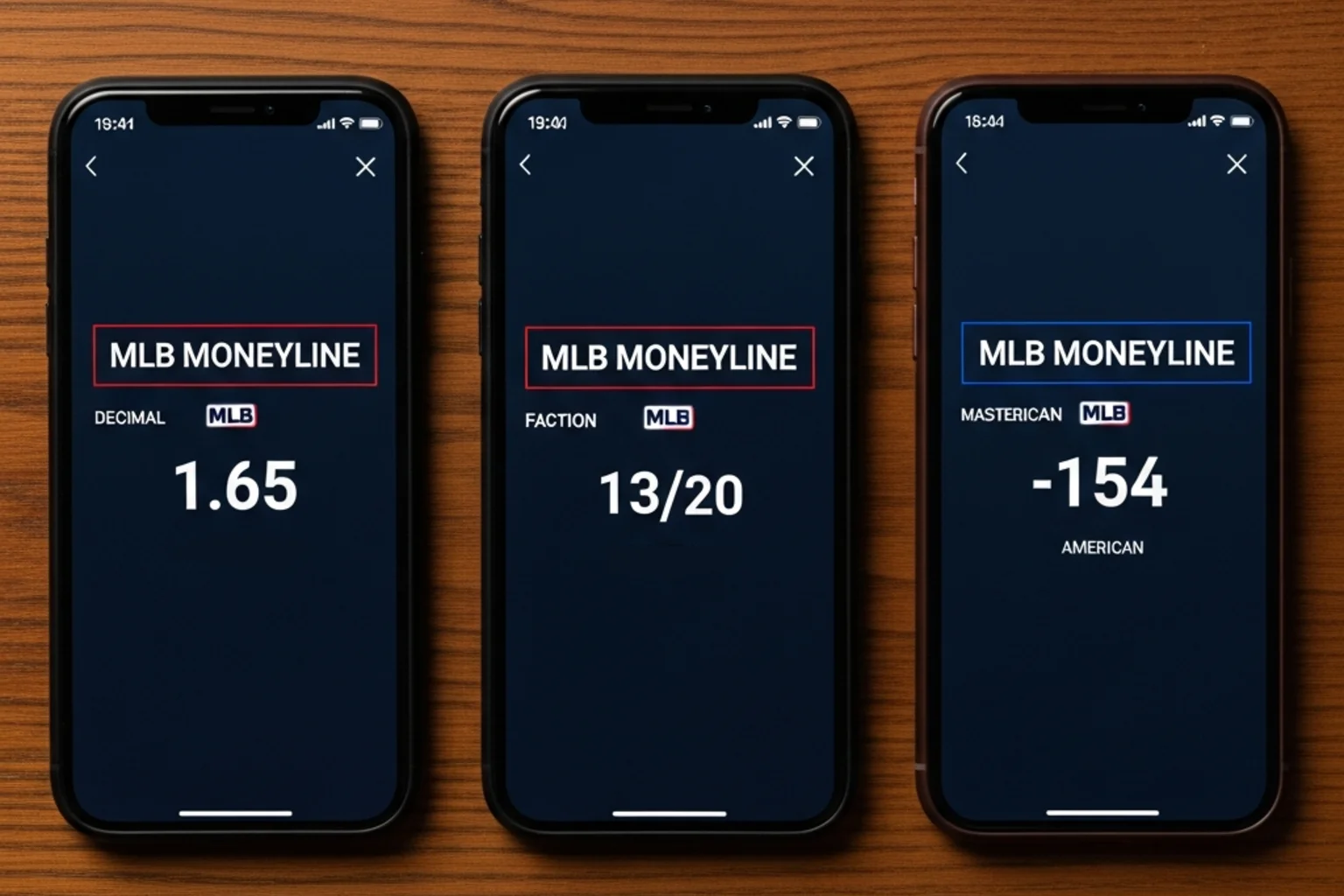
Table of Contents
- Why MLB punishes UK bettors who only speak one odds format
- Decimal odds: the format that doesn’t lie about returns
- American odds: the format the analytical content uses
- Fractional odds: the format your dad still uses
- The conversion table that lives in your head
- Implied probability and why it changes the conversation
- Frequently asked questions on MLB odds formats
Why MLB punishes UK bettors who only speak one odds format
The phone call that convinced me to write a serious primer on odds formats came from a friend in Birmingham who had just talked himself out of a value bet on a Yankees moneyline. He’d seen the American price at -130 on a US betting blog, mentally converted it to “you’d need to stake 130 to win 100, so it’s basically evens,” and decided the price was tight. The actual decimal was 1.77 — a clearly favourable price for the matchup he’d been researching. He had it in his head, but he couldn’t get it out of his head in the right number system.
MLB is the sport where this language problem hits UK punters hardest. The reason: US analytical content dominates the baseball discussion online, and US analysts use American odds (-130, +145, +200) by default. Meanwhile, UK-licensed bookmakers display in decimal or fractional. Pickswise, Action Network, Covers, and the underlying MLB betting universe assumes American. UK shops and online operators assume decimal. The same price gets shown three different ways depending on where you read it.
The practical implication is that a serious UK MLB punter needs all three formats fluent enough to recognise prices at a glance. Not converted with a calculator — recognised. -130 should trigger “1.77” in your head before the conversation moves on. 2.30 should trigger “+130.” 6/4 should trigger “2.50.” Until those translations are automatic, you’re missing value because you can’t read it quickly enough.
This is not a beginner topic dressed up as advanced. It’s an operational competence that separates UK punters who source intelligence from US analysts from UK punters who only read UK content. The first group has a wider information base.
Decimal odds: the format that doesn’t lie about returns
Decimal odds are the cleanest format for one reason: the number is the total return per unit staked, not the profit. A £10 bet at decimal 2.50 returns £25 — £10 stake back plus £15 profit. The number is the multiplier. No mental conversion is needed to figure out what you get back.
Implied probability from decimal is one over the price. Decimal 2.00 = 1/2.00 = 50 percent. Decimal 1.50 = 1/1.50 = 66.7 percent. Decimal 4.00 = 25 percent. Memorise a few key conversions: 1.50 = 66.7%, 2.00 = 50%, 2.50 = 40%, 3.00 = 33.3%, 4.00 = 25%, 5.00 = 20%, 10.00 = 10%. With those anchor points you can interpolate every price in between in under a second.
The decimal-odds standard is used across continental Europe, most UK online sportsbooks, and Australia. UK Gambling Commission-regulated operators all support decimal display, with most defaulting to it for new accounts. The format is mathematically unambiguous, which is why every quantitative betting analyst uses it.
One nuance: decimal odds round to two decimal places typically. Some exchange platforms display three decimal places (Betfair, for instance, shows 2.42 or 2.46). The third decimal places matters at scale — a difference between 2.42 and 2.48 on a £100 bet is £6 in returns, and across hundreds of bets this compounds. Decimal is the only format where these small price differences are immediately visible.
American odds: the format the analytical content uses
American odds are signed numbers. Positive numbers indicate underdogs and tell you how much profit you get on a 100-unit stake. +130 means a 100-unit stake returns 130 in profit (plus the 100 stake back). Negative numbers indicate favourites and tell you how much you need to stake to win 100 in profit. -150 means a 150-unit stake wins 100 in profit. The “100” is a notional reference, not an actual unit — you stake whatever you stake, and the ratio scales.
Converting American to decimal is two formulas. For positive American odds (underdogs): decimal = (American/100) + 1. So +150 = (150/100) + 1 = 2.50. For negative American odds (favourites): decimal = (100/abs(American)) + 1. So -150 = (100/150) + 1 = 1.67.
The break-even arithmetic is helpful. -110 in American is decimal 1.91, which implies 52.4 percent probability — this is the standard “juiced” line on most US sports markets, and recognising -110 instantly as roughly even money is essential. +100 (also called “even money” or “pick’em”) is decimal 2.00, 50 percent implied. Everything centred on -110 reflects the typical 4.5 percent hold US books charge on balanced two-sided markets.
American odds appear everywhere in US-sourced MLB analysis. If you’re reading Pickswise, Action Network, or Covers for matchup notes — and most serious MLB analysis sits in that ecosystem — you’ll need to translate +130 to 2.30, -180 to 1.56, +250 to 3.50 in real time. With practice this becomes effortless. The 2025 US handle of $166.94 billion across legal sportsbooks generates a vast information ecosystem priced in American, and UK punters who can read it have an information advantage over UK punters who can’t.
Fractional odds: the format your dad still uses
Fractional odds are the traditional UK format, descended from horse racing and still dominant in high-street betting shops. 6/4 is read “six-to-four.” It means you win 6 units for every 4 units staked. Total return on a 4-unit stake is 10 (the 6 profit plus the 4 stake).
Conversion to decimal: divide numerator by denominator, then add 1. 6/4 = (6/4) + 1 = 2.50. 7/2 = 3.50 + 1 = 4.50. 1/2 = 0.5 + 1 = 1.50. The fraction is profit-to-stake; the +1 converts to total-return-per-unit.
Familiar fractional anchors for UK punters: evens = 1/1 = decimal 2.00. 6/4 = 2.50. 2/1 = 3.00. 5/2 = 3.50. 3/1 = 4.00. 5/1 = 6.00. 10/1 = 11.00. Going the other way, 1/2 (odds-on) = 1.50. 4/9 = 1.44. 4/5 = 1.80.
UK high-street betting shops, the 5,825 outlets active across Great Britain as of March 2025 (down nearly 30 percent from the 8,304 of 2019), still default to fractional odds on their display boards. Many UK online operators offer fractional as a display option, with decimal as the alternative. American odds are rarely offered as a display option by UK-licensed operators — you have to convert yourself.
The reason fractional persists in the UK is partly tradition, partly familiarity for racing-first punters. Football and racing fans grew up with 7/2 and 11/4. MLB, being a US sport, naturally pulls toward American odds in the analytical layer, and bookmakers display in decimal. So a UK MLB bettor sits at an awkward intersection: traditional formats they grew up with (fractional), the format their book uses (decimal), and the format the analysis uses (American). Three languages, one bet.
The conversion table that lives in your head
Once a few core conversions are committed to memory, the rest interpolate. The table I keep in my head, refined over years of constant use, covers about 15 prices that anchor the entire MLB betting universe.
Even money: decimal 2.00 = American +100 = fractional 1/1 = evens = 50.0 percent implied probability.
Light favourite: decimal 1.91 = American -110 = fractional 10/11 = 52.4 percent. This is the “juiced” coin flip — almost every US two-sided market sits here.
Standard favourite: decimal 1.83 = American -120 = fractional 5/6 = 54.5 percent. Common for slight MLB favourites at home with a decent pitching matchup.
Mid-strength favourite: decimal 1.67 = American -150 = fractional 4/6 = 60.0 percent. Where a meaningful pitching advantage starts showing up.
Strong favourite: decimal 1.50 = American -200 = fractional 1/2 = 66.7 percent. A solid favourite with a small but real edge.
Heavy favourite: decimal 1.33 = American -300 = fractional 1/3 = 75.0 percent. Approach with caution — break-even rate is high.
Light underdog: decimal 2.30 = American +130 = fractional 13/10 = 43.5 percent. The bread-and-butter underdog tier where value often lives.
Mid underdog: decimal 2.75 = American +175 = fractional 7/4 = 36.4 percent. Common pricing for moderate underdogs in pitcher’s duels.
Strong underdog: decimal 3.50 = American +250 = fractional 5/2 = 28.6 percent. Where contrarian plays start producing meaningful returns when they hit.
Long shot: decimal 6.00 = American +500 = fractional 5/1 = 16.7 percent. Common for cross-divisional underdogs facing aces.
Memorising these ten prices in all three formats is the work of a couple of evenings. After that, fluency follows quickly because every other price interpolates between them.
Implied probability and why it changes the conversation
Once you’ve internalised the three formats and can convert between them, the next step is thinking in implied probability rather than price. Implied probability is the number that makes betting maths possible.
If a moneyline is priced at decimal 2.00 (50 percent implied) and you genuinely believe the true probability is 55 percent, you have positive expected value. Stake £100 a hundred times, and you lose 45 of them (losing £4,500) and win 55 of them (winning £5,500). Net result: +£1,000 across 100 bets, or +10 percent ROI. The £100 figures are illustrative — what matters is the percentage edge over implied.
The implied probabilities of both sides of a moneyline always sum to more than 100 percent because of bookmaker margin. A market where the home team is 1.80 (55.6 percent) and the away team is 2.20 (45.5 percent) has a combined implied total of 101.1 percent. The 1.1 percent above 100 is the vig — the bookmaker’s edge.
MLB moneyline vig at UK-licensed operators typically sits at 3 to 5 percent on most fixtures, slightly tighter on high-liquidity games and slightly wider on small-market matchups. US sportsbook hold rates ran around 10.2 percent across all markets in 2025; the MLB-specific moneyline figure is meaningfully tighter because of liquidity. Comparing implied probabilities across two operators on the same fixture is the single fastest way to spot a value line — if one book has the home team at 53 percent implied and another at 56 percent, the 53 percent book is offering better value if your analytical work says the true probability is anywhere above the bookmaker’s lower estimate.
For the practical application of implied probability to line shopping and closing line value, the MLB line shopping and CLV framework walks through how to turn implied-probability fluency into measurable ROI improvement over a season.
Frequently asked questions on MLB odds formats
Why do UK bookmakers show MLB in fractional but US sites in American?
UK bookmaker conventions descend from horse racing tradition where fractional odds were standard. US sportsbooks developed their own American-format system independently. Both formats encode identical pricing information; the visual difference is purely cultural.
How do I quickly convert -150 to decimal in my head?
For negative American odds, divide 100 by the absolute value of the American figure, then add 1. So -150 becomes (100 divided by 150) plus 1, which equals 1.67 in decimal. With practice this conversion takes under a second.
Prepared by the mlb Online Betting editorial staff.