Three-Way Moneyline in MLB Betting
 Available in US
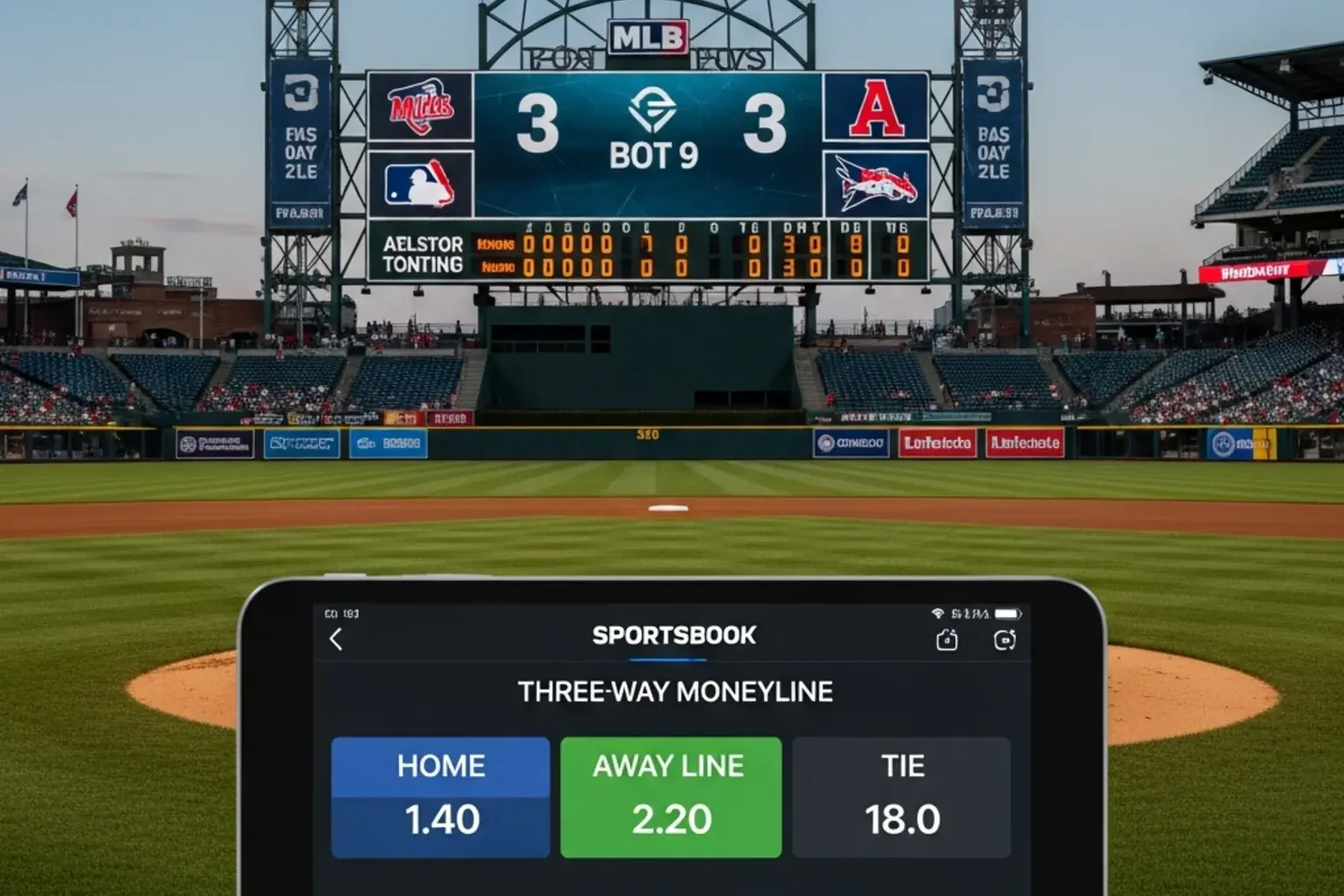
Table of Contents
The market that lets baseball end in a draw
The first three-way moneyline I bet on cost me nothing to learn from, because I didn’t bet it — I just watched. A friend in Manchester took the draw at 6/1 on a Pirates-Brewers fixture that was tied 2-2 after nine, and his ticket cashed before extra innings even started. I asked him how he had spotted it. “Two ace starters, weak bullpens, low total. The draw was the second-most-likely outcome and the price said it was the seventh.” That sentence stuck with me as the cleanest summary of why three-way ML exists.
Three-way moneyline on MLB pays out on the result after exactly nine innings, with three possible outcomes: home win, away win, or tie. Unlike the standard two-way moneyline, which goes to extra innings until somebody wins, the three-way line treats a 4-4 score at the end of the ninth as a settled tie. The draw becomes a third betting option, priced according to its probability.
The market exists because of how baseball actually plays out. Roughly 9 to 11 percent of MLB regular-season games are tied after nine innings, which is a much higher draw frequency than UK punters might expect given that the sport “never ends in a tie.” Those tied-after-nine games eventually resolve in extra innings under the ghost-runner rule, but the three-way ML stops at the end of regulation. The 9 to 11 percent draw rate translates to fair-value draw prices in the 8.00 to 10.00 decimal range — which is exactly where good books quote them.
The reason this market is worth knowing about, even if you never bet it, is that it forces you to think about run distributions instead of just win-loss outcomes. That mental shift improves how you read every other MLB market.
How the three-way works in practice
The three-way moneyline is priced exactly as a football match-result market would be. Three outcomes, three prices, summing to slightly more than 100 percent implied probability because of the bookmaker margin.
An example. Home team 1.95 to win in nine innings. Away team 3.20 to win in nine. Draw at 9.00. Implied probabilities: 51.3 percent, 31.3 percent, 11.1 percent. Sum: 93.7 percent in fair terms before vig — the book has actually padded each side so the implied-percent total exceeds 100 percent and produces their margin. The shape is identical to a Premier League match-result market.
The key difference from a two-way ML is the implied probability redistribution. On the same fixture, the two-way ML might be home team 1.80 and away team 2.10 — a 55.6/47.6 split that totals 103.2 percent (the 3.2 percent above 100 is vig). The two-way prices include both regulation wins and extra-innings wins. The three-way prices regulation wins only, with the draw absorbing the tied-after-nine outcomes that the two-way bundles into one team or the other.
This is why three-way home and away prices are always longer (higher decimal odds) than the two-way equivalents on the same fixture. The probabilities have been split three ways, and any extra-innings outcome that would have settled a two-way ML now settles the draw instead.
One quirk: a few UK-licensed operators offer a “draw refund” version of the two-way ML on selected markets — if the game is tied after nine, the bet pushes. Mechanically this is closer to two-way ML with a built-in draw-no-bet, not true three-way ML. Make sure you know which version you’re looking at before placing a stake.
The pricing gap between three-way and two-way
The arithmetic of converting between three-way and two-way prices is something every MLB punter should be able to do roughly in their head, because the comparison reveals what the market thinks about run-scoring distributions.
Start with a real-shape example. Two-way: home 1.70, away 2.20. Three-way: home 2.00, away 2.80, draw 8.50. Take the two-way home price of 1.70 — implied 58.8 percent — and subtract half the draw probability (5.9 percent, half of 11.8 percent). You arrive at about 52.9 percent expected regulation-only win probability, which translates to decimal 1.89. The actual three-way home price is 2.00, suggesting the book has loaded a touch of extra margin onto the regulation-only price. That extra tenth of vig is normal — three-way markets carry slightly higher hold than two-way moneylines.
What this means in practice: the three-way ML home and away prices are usually 0.20 to 0.40 longer than the two-way equivalents. The draw price floats between 7.50 and 10.00 for normal matchups, longer for blowouts where the favourite is heavily expected to lead by multiple runs going into the ninth. For low-scoring, evenly-matched fixtures, the draw can dip to 6.50 — which is actually a reasonable hit-rate price for a true coin-flip pitcher’s duel.
The natural comparison market is the MLB run line and its mechanics, because both markets force you to think about margin of victory rather than just outcome. Three-way moneyline asks “does either team win by any margin in nine innings?” Run line asks “by how much?” They reward different kinds of analytical work.
When the draw is genuinely value
The interesting question is when the draw price at 9.00 or 10.00 represents real value rather than a long-shot tax. The conditions are specific.
The draw value lives in low-scoring, evenly-matched games with strong starters and weak offences. Pitcher’s duels in pitcher-friendly parks produce a meaningful share of 1-1, 2-2, and 0-0-through-nine results. Petco Park, Tropicana Field, and Oracle Park in San Francisco have historically run higher tied-after-nine rates than league average. Add two starters with combined ERAs under 6.50 and FIPs (fielding-independent pitching, a measure stripping out defensive variance) under 7.00, and you have the recipe for a draw at 8.00 or 9.00 to outperform its implied probability.
The hostile environment for draws is the opposite: hitter-friendly parks (Coors, Globe Life, Citizens Bank), warm summer evenings, and starters with combined ERAs above 8.50. Those games average over the total, produce two-or-three-run scoring innings, and almost never finish tied after nine. The draw price might still float at 10.00 but the implied 10 percent is generous to the punter — the actual rate in those conditions is closer to 5 to 6 percent.
The strategic use is selective. Draws are not a portfolio market — you cannot bet a slate of three draws a night and expect to break even. They are an angle bet for the right matchup, taken occasionally, sized small. Treat the draw price as you would treat a longshot first-goalscorer in football: identify the conditions where the true probability exceeds the implied probability, and bet only there. Bill Miller of the American Gaming Association made a related observation about the broader betting market in early 2026, noting that “with 2025 marking another record year, the industry’s performance reinforces a clear principle.” The principle, paraphrased for our purposes, is that disciplined market selection beats reflexive market participation.
Extra innings and the settlement edge case
Three-way moneyline settlement happens at the end of nine innings. What happens after that — extra innings, walk-off home runs, lengthy 18-inning marathons — is irrelevant to the bet. The score after the home half of the ninth inning is final.
This is the cleanest part of the three-way market. There is no extra-innings risk to your bet. A 3-3 game heading to extras settles the draw immediately. A 4-3 lead in the ninth that survives the bottom half settles the home or away win. Whatever happens in extras is somebody else’s problem.
The mechanics of the rule are worth committing to memory. If the home team is winning after the top of the ninth, the bottom of the ninth is not played — the home win is settled and the game ends. That is the standard MLB walk-off rule, and the three-way moneyline settles accordingly. If the home team is trailing or tied after the top of the ninth, they bat the bottom of the ninth, and the score after that half-inning is the three-way settlement.
One niche scenario: rain-shortened games called before the end of the ninth. UK-licensed operators handle this differently. Some void three-way bets if the game is called before nine innings complete. Others settle on the score at the point of suspension if the game is “official” (five innings, or four and a half with the home team ahead). Read the book’s terms once at registration, because this rule never makes headlines until your bet is the one affected.
UK bookmaker coverage of three-way MLB
Three-way moneyline is not standard across UK-licensed sportsbooks on MLB. Major operators including bet365, Betfair, and William Hill quote three-way on a meaningful share of MLB games, particularly headline fixtures and weekend slates. Mid-tier and smaller UK books — and the betting shop estate, which has shrunk to 5,825 outlets across Great Britain as of March 2025, down nearly 30 percent from 2019 — generally skip three-way MLB entirely.
The market is most reliable to find on Yankees, Red Sox, Dodgers, and Mets games, where the betting volume justifies the trading desk’s effort to price a more complex market. Smaller-market matchups — say, a midweek Pirates-Marlins game — often appear with only two-way ML, run line, and totals on the standard slate.
If you want to bet three-way regularly, two-account redundancy is sensible. Keep one large UK book account for liquidity and one mid-sized account for line variation. The draw price on the same fixture can vary by a full decimal point between two operators on slower trading days, and that variance is where line-shopping value lives.
Frequently asked questions on the three-way MLB moneyline
How is a draw possible in a three-way MLB moneyline if baseball has no ties?
The three-way market settles after exactly nine innings of regulation play. Any game tied at that point is graded as a draw on the three-way line, regardless of what happens in extra innings.
Which UK bookmakers price three-way MLB moneylines?
Larger UK-licensed operators such as bet365, Betfair, and William Hill quote three-way moneyline on most marquee MLB games. Mid-sized books and high-street brands typically offer only two-way moneyline and run line on smaller-market matchups.
Should I bet three-way or two-way on heavy favourites?
On heavy favourites the three-way price is longer because regulation-only wins are less probable than wins-including-extras. If you genuinely expect a multi-run regulation victory, the three-way price offers more value than the same teams two-way moneyline.
Written by the editors at mlb Online Betting.