The MLB Run Line Explained: How the ±1.5 Handicap Works
 Available in US
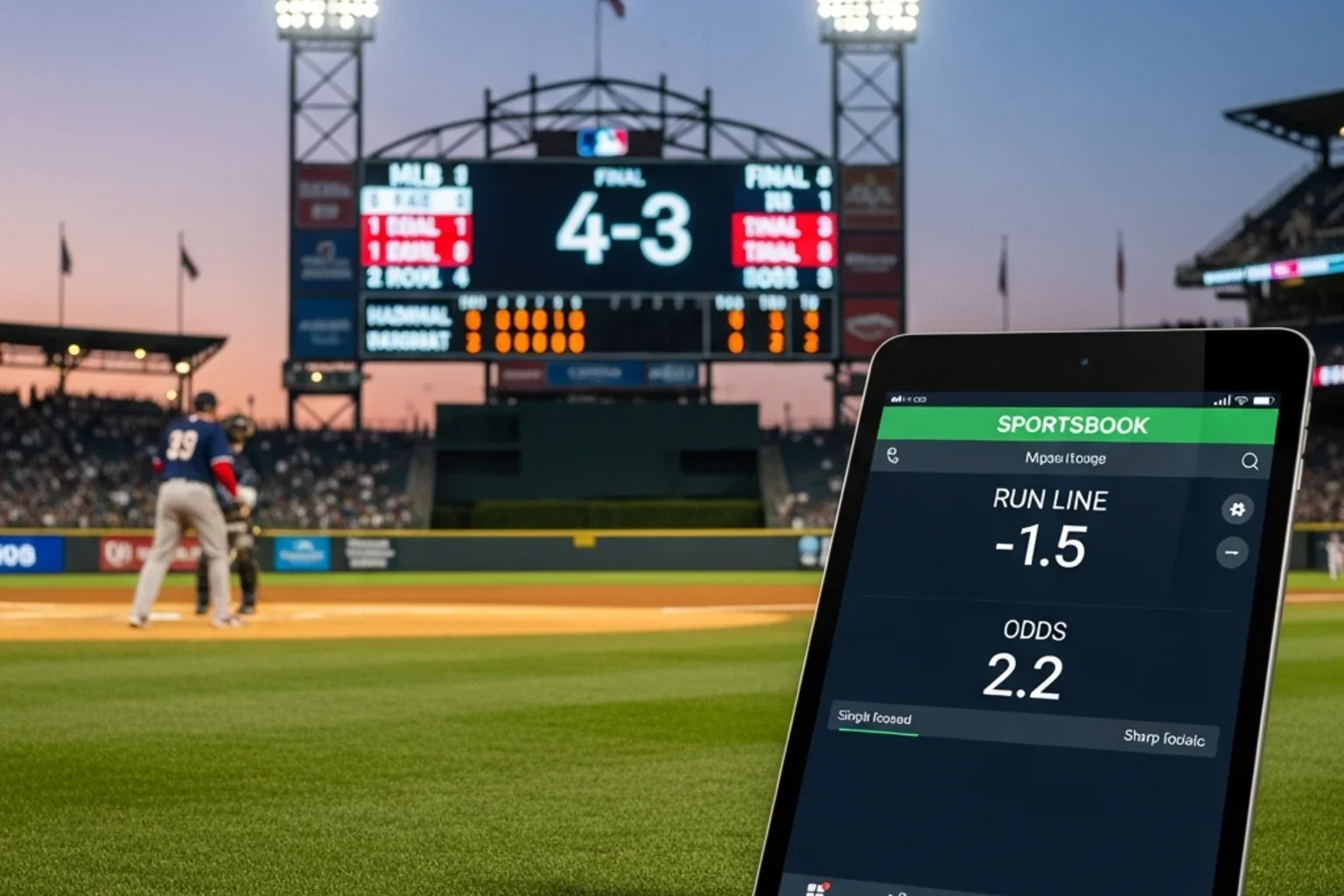
Table of Contents
- Why the run line behaves nothing like a football handicap
- What the price tag really tells you
- The favourite worked example, with the maths in plain sight
- Underdog +1.5 and the trap that catches Premier League minds
- When the run line is the right answer
- Alternate run lines and where they actually pay
- Frequently asked questions on the MLB run line
Why the run line behaves nothing like a football handicap
The first time someone asked me to explain the MLB run line on a phone call at half eleven, I made the mistake every Premier League punter makes: I called it a handicap and stopped there. They came back two minutes later asking why their -1.5 favourite at 2.30 had lost when the team won 4-3. That single phone call taught me to lead with the mechanics instead of the label.
A run line is a fixed handicap of one and a half runs, and the price is what moves. The favourite must win by two runs or more; the underdog covers either by winning outright or by losing by exactly one. That fixed margin is the reason MLB betting feels strange to a UK punter weaned on Asian handicaps and football spreads, where the line itself flexes from -0.5 to -2.5 depending on the matchup. In baseball, the margin is locked, and the only variable a sportsbook can lean on is the odds.
The structural reason for that lock is the run-scoring distribution itself. The 2025 World Series between the Blue Jays and Dodgers ran the full seven games, with Game 3 stretching to 18 innings — that kind of marathon underlines how compressed normal MLB run-scoring actually is. About 28 to 30 percent of regular-season games end with a one-run final margin, which is why bookmakers can hold the spread at 1.5 and still write profitable lines on both sides. If they moved it to 2.5 or 0.5, half the typical pricing logic collapses.
The run line is also the cleanest way to express conviction on a heavy favourite without taking a tiny moneyline price. A 1.40 favourite is unappealing as a single bet, but the same team at -1.5 on the run line might come back at 2.10. You are betting on margin, not just outcome, and that distinction is the entire game.
What the price tag really tells you
Here is a trick I picked up around year three: read the run-line price before you read the moneyline. The run line is more honest about how the market sees the matchup, because it tells you what bookmakers think about the size of the win, not just the binary result.
The mechanics work like this. The favourite is shown as -1.5 with a positive price — usually somewhere between 1.85 and 2.50 in decimal, or 6/7 to 6/4 in fractional terms common to UK shops. The underdog is +1.5 with a shorter price, typically 1.55 to 1.95. Bookmakers build these prices so that, in theory, a £100 bet on each side would lose them only their margin. Out of the 162-game regular season with 2,430 fixtures, this matters because the slate is enormous and every percent of edge compounds.
If you want to swap formats fluently, the MLB moneyline at UK customer-facing books sits right next to the run line on every fixture page, and reading both together is the single fastest way to understand how the book has graded the matchup.
Two terms worth defining now. Implied probability is the percentage chance baked into a price — decimal 2.00 implies 50 percent, decimal 1.50 implies 66.7 percent. Vigorish, or vig, is the margin the bookmaker adds; on MLB run lines that vig typically lands between 4 and 6 percent of combined book. When you compare two operators’ run-line prices on the same fixture and find a 3-cent gap in American odds, you have just identified about 1.5 percent of expected value. That kind of gap is normal on a busy summer evening with twelve games on the slate.
The run line is also why I get questions about pushes. The answer is no — because the line ends in .5, you cannot tie it. Either you win by two or you do not. The 12-month MLB schedule, with its mid-week three-game series and exhausting bullpens, produces enough variance that the difference between -1 and -2 final margins is a coin flip on most fixtures.
The favourite worked example, with the maths in plain sight
Let me run a concrete example. Suppose the Dodgers are 1.45 on the moneyline against a divisional rival, and -1.5 on the run line at 2.10. You like Los Angeles strongly. The decision tree is straightforward.
£20 on the moneyline at 1.45 returns £29 if the Dodgers win by any margin. Profit: £9. £20 on the run line at 2.10 returns £42 if the Dodgers win by two or more. Profit: £22. The difference between a one-run win and a two-run win, in this case, is £13 — over half your stake again. That gap is exactly why the run line exists.
Now flip it. If the Dodgers win 3-2, the moneyline cashes, the run line loses. If they win 5-2, both cash. The break-even calculation matters: you need the run line to clear 1.5 about 47 percent of the time at 2.10 to break even, but a 1.45 moneyline favourite cashes around 70 percent of the time historically. The interesting question is whether that 70 percent contains enough two-run-plus wins to justify the price.
Reference points help here. In Game 7 of the 2025 World Series, 68 percent of wagers and 70 percent of money at BetMGM landed on the Blue Jays. The line implied the result was close to a coin flip. That kind of split tells you the market itself is unsure whether the favourite’s win will be two-run-decisive or single-run-tight. The run line is where that uncertainty gets priced most cleanly.
One trap to avoid: don’t read a -1.5 favourite at 2.10 as “double my money if they win by two.” Read it as “the market thinks they win by two or more about 47.6 percent of the time.” Those are not the same sentence, and the second one stops you taking bad prices.
Underdog +1.5 and the trap that catches Premier League minds
The underdog run line is where most football punters get burned. A team at +1.5 on the run line will sometimes be priced shorter than the same team’s moneyline — and I mean shorter, as in lower decimal odds — and the instinct is to call that a free hit. It isn’t.
Take a real-shape example. The Pirates are 3.40 on the moneyline against the Yankees and +1.5 on the run line at 1.60. The implied probability swings from 29.4 percent to 62.5 percent. That gap reflects something specific: the Pirates “cover” the run line if they win outright or lose by one. Lose by two or more, and the bet loses. Bookmakers have priced in just how often baseball produces one-run games — heavy enough that an underdog covering the run line nearly two-thirds of the time becomes the base case.
The trap is double-counting. A football punter sees +1.5 and assumes “extra cushion = safer bet at long odds.” But the cushion is already priced in. A £20 bet on the underdog moneyline at 3.40 returns £68. The same £20 on +1.5 at 1.60 returns £32. The maths only favours the run line if you genuinely believe the underdog will keep the game inside one run more than 62.5 percent of the time, which is a much narrower edge than the headline price suggests.
Where the +1.5 actually shines is in pitcher-dominated matchups — two strong starters squaring off in a low-scoring environment. Those games trend toward 3-2, 2-1, 1-0 finishes, and the underdog cushion converts most of the time. Tight ballparks help too. The mistake is using +1.5 on slugfests at hitter-friendly venues where a six-run swing in the eighth inning blows the bet apart.
When the run line is the right answer
About four years ago I started keeping a private log of every fixture where I picked moneyline versus run line. The split that emerged: heavy favourites against poor opposition with rested bullpens cashed the run line cleanly; coin-flip matchups did not. That informed every run-line decision since.
The favourite run line works when three things line up. The starting pitcher has a multi-inning leash, meaning a manager who lets him go seven-plus rather than yanking him in the fifth. The bullpen behind him is rested, not coming off three consecutive use-days. And the opposition lineup has a recent batting average below the league norm — say, below .230 — against same-handed pitching. Those three together produce blowouts more often than a flat moneyline expects.
The underdog run line works in the inverse environment: two strong starters, a pitcher-friendly park such as Petco or Tropicana, and recent bullpen usage on both sides that points to a low-scoring affair. When I see two starters with combined ERAs under 7.50 and FIPs (fielding-independent pitching, a metric that strips out defensive luck) under 8.00, I’m interested in +1.5.
One more situational angle worth flagging. Average MLB game time in 2025 was just 2 hours 38 minutes, a third straight season inside that 2:40 ceiling. Shorter games mean tighter run distributions overall — fewer late-inning blowouts caused by tired arms in extra innings. That structural change has nudged single-run finals upward across the league, making the underdog run line slightly more valuable than it was five years ago. Sharp UK bookmakers price this in already, but the secondary lines at smaller books sometimes lag.
Andrew Rhodes at the UK Gambling Commission described Britain in May 2024 as “home to the largest regulated online gambling market in the world, with a gross value now north of £15 billion, with some 22.5 million adults engaging on a regular basis.” The reason that matters here: trading desks for run-line markets in the UK are competing inside a deep, regulated market with serious liquidity, so the prices you see are sharper than what punters in smaller jurisdictions encounter on the same fixtures.
Alternate run lines and where they actually pay
Alternate run lines extend the basic concept. Instead of just -1.5 and +1.5, you can take -2.5, -3.5, +2.5, even +3.5 at most UK-licensed books that cover MLB. The further from the standard line, the more dramatic the price swing.
A -2.5 favourite on the Yankees at 3.50 turns into a serious value play when the matchup screams blowout — exhausted opposition starter, ten-run-line offence at home, weak bullpen on the other side. The flip side: +2.5 underdog at 1.30 looks attractive for cautious bettors, but the implied probability is around 77 percent, which is a hard rate to clear unless you’re highly selective about pitching matchups.
My personal rule for alternate lines is to use them only when the standard run line price is sitting at extremes — sub-1.80 favourites or sub-1.40 underdogs. At those edges, the alternate market often prices the next step too aggressively, and value spills sideways. Keep them as a tool, not a main course.
Frequently asked questions on the MLB run line
What does -1.5 mean on an MLB run line?
The favourite must win the game by two runs or more for the bet to settle as a winner. A one-run victory loses the bet despite winning the game outright.
Why is the underdog +1.5 sometimes priced shorter than the moneyline?
Because MLB produces a high share of one-run games, around 28 to 30 percent of fixtures. Covering by a single run is much more likely than winning outright, so the bookmaker prices the +1.5 underdog at lower decimal odds to reflect that elevated probability.
Can the MLB run line push?
No. The line is set at 1.5, so a tie outcome on the spread is impossible. The favourite either wins by two or more, or the underdog covers.
Written by the editors at mlb Online Betting.