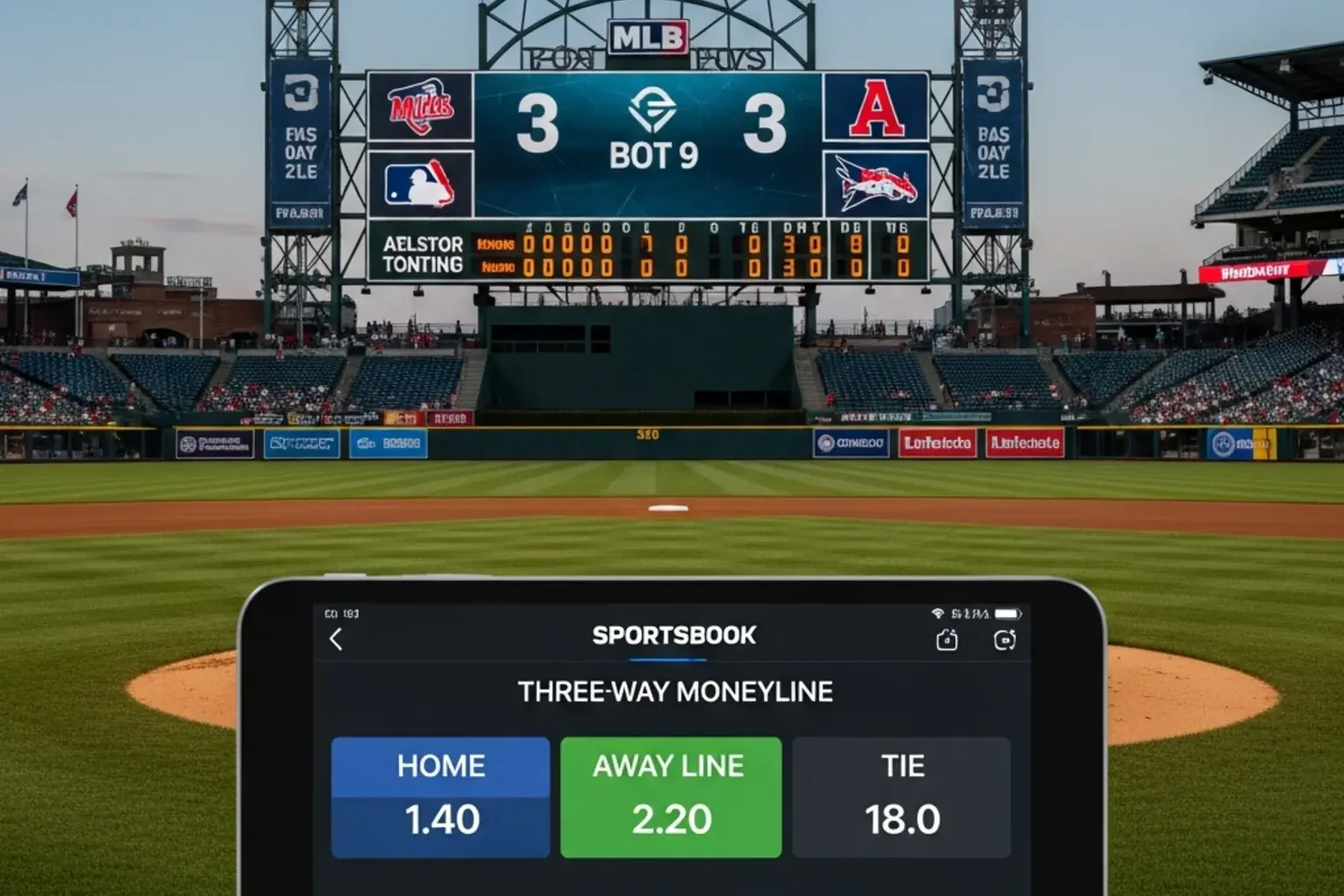
First Five Innings (F5) Betting on MLB
 Available in US

The bet that ignores half the game on purpose
The first time I posted an F5 ticket to my screenshot folder was after watching a bullpen blow a 6-2 lead in the eighth inning of a Friday night game I had bet the favourite on. The full-game moneyline lost. The F5 line — same favourite, leading after five — would have cashed comfortably. That contrast is the entire pitch for first-five-innings betting.
F5 betting is a wager whose settlement is fixed at the score after five full innings. The standard formulations are F5 moneyline (which team leads), F5 run line (the same 1.5 spread applied to the first half of the game), and F5 totals (over or under on combined runs through five innings). All three exclude everything that happens from the sixth inning onward.
The structural appeal for a UK punter is straightforward. Most MLB starting pitchers throw five to six innings these days, so an F5 bet is essentially a bet on the starting pitchers and their teams’ offences, with the relief corps removed from the equation. Relief volatility — and modern bullpens are extremely volatile, with closers blowing roughly one in five save opportunities league-wide — is filtered out. You are betting on a smaller, more predictable slice of the game.
The market is also a smart hedge in matchups where the starter clearly outclasses the bullpen behind him. A starter with a 2.85 ERA backed by a bullpen running 4.80 ERA tells you exactly where the value sits: in the first half of the game. The F5 line captures that asymmetry. The full-game line averages it out.
What “first five” actually settles on
The grading rules matter, because they catch the unwary. F5 lines settle after five completed innings, which means the home team must bat the bottom of the fifth even if it leads — there is no walk-off equivalent that ends the half-inning early at the F5 stage. The score on the scoreboard after the home half of the fifth is the final F5 number.
If a game is suspended or rain-shortened before five complete innings finish, F5 bets typically void and stakes are refunded at most UK-licensed operators. The exact rule varies by book and is buried in the MLB-specific section of their terms. A handful of books grade F5 totals as “no action” if the game is called before five, while grading F5 moneyline on the score at the point of suspension if at least four and a half innings have been played. Reading the rules once, properly, saves a lot of disputes later.
Extra innings do not factor into F5 settlement. The F5 line ends at five innings whether the game itself runs nine, eleven, or fifteen total. That makes the F5 totals market in particular feel cleaner than the full-game version, which has to account for the small but real possibility of a 16-inning marathon.
There is one common confusion worth heading off. A pitcher being pulled before the fifth inning — for injury, performance, or strategy — does not void the F5 bet. The bet pays out on whoever leads after five completed innings, regardless of which pitchers were on the mound to produce that score. The bet is on the team, not the starter.
F5 versus full-game: where the prices diverge
A team that is 1.85 on the full-game moneyline might come back at 1.70 on the F5 line — that is, shorter odds for the first half of the game. The market is telling you something specific: the favourite is sharper in the early innings, the underdog catches up later.
The compression works because bullpens equalise late-game pricing. Even mediocre teams have a few reliable relief arms. A team with a poor offence and a weak rotation can still ride one good reliever through a high-leverage seventh inning, and that dynamic makes most full-game lines look more competitive than the underlying matchup justifies. The F5 line strips out the bullpen, exposes the starting-pitching gap, and prices accordingly.
An example, with rough numbers from the kind of matchup that repeats often. Full game: home favourite 1.65, away underdog 2.40. F5: home favourite 1.55, away underdog 2.65. The home team’s implied probability rises from 60.6 percent on the full-game line to 64.5 percent on the F5 line — a 4 percentage-point swing. That swing is the bookmaker’s expression of how much of the home team’s edge sits in the rotation versus the bullpen.
The pricing trap to avoid: don’t blindly take F5 favourites because “starting pitchers are more predictable.” They are, but the price already reflects that. Edge in F5 comes from situations where the market has underweighted the pitching gap — for instance, a young ace with twelve starts of dominance still being priced near his preseason expectation, when in fact his run-allowed rate over the last two months is far better than the headline number suggests.
When the F5 market is the right tool
Three matchup profiles where I lean F5 by default, refined over a decade of MLB betting.
The first is the elite starter against a poor lineup with a fragile bullpen behind him. The full-game line on this team is rarely generous, but the F5 line lets you isolate the matchup that matters. You are not asking the question “does this team’s bullpen hold a 4-1 lead in the eighth?” You are asking “does this starter shut this lineup down for five innings?” The second question has a higher confidence rate.
The second is the heavy day-game lineup against an opposing starter on short rest. Day games favour starters who can pound the strike zone in two-strike counts because hitter visibility is worse and reaction time tighter; the F5 line for the right matchup here can be excellent value. UK punters often have day-game access during European afternoon slots, before the main slate starts, which is a small lifestyle advantage worth using.
The third is the divisional rivalry where bullpens are over-extended from the rest of the series. A four-game series in late August with both teams pushing for the postseason will leave both bullpens shredded by the third game. The F5 line on Day 3 of that series captures the starting pitching matchup before the rested-versus-tired bullpen mess takes over. If you want a fuller view of how pitching analytics actually flow into prices, the MLB pitching analytics framework for betting decisions covers the metrics that drive these read-outs.
Two scenarios where F5 is the wrong tool. The first is when both teams’ rotations are middling and the contrast lives in the bullpens — full-game lines reflect that asymmetry better. The second is when one team carries an obviously stronger offensive matchup against the opposing starter — the F5 line will reflect this, but typically with thin vig efficiency, and you get more meat on the bone betting the team’s full-game total over rather than the F5 moneyline.
F5 totals: the cleaner totals bet
F5 totals are an underrated market. The line is usually set somewhere between 4 and 5.5 runs, with most settings at 4.5 — the half-run version because of the same no-push convention as full-game totals.
What makes F5 totals appealing is that they remove most of the relief-pitching noise that drags full-game totals into wide variance. Five innings of starting pitching against two lineups is a more bounded set of outcomes than nine innings with three different relievers from each side. The totals line follows the same logic as full-game totals — ballpark factor, weather, lineup quality, starter projections — but with a tighter range and lower variance per bet.
A practical angle: F5 unders thrive in matchups where both starters have above-average strikeout rates and average control rates, because strikeouts limit run-scoring efficiency more than any other single pitching outcome. F5 overs thrive in hitter-friendly venues during summer evenings where both starters have above-average opposing batting averages on balls in play — meaning hitters are squaring up pitches, not just walking into outs.
Live F5 totals exist but liquidity is thinner. Most UK-licensed operators offer the line pre-game and suspend it once the first pitch is thrown, reopening occasionally with limited stake limits. If you want to bet F5 in-play, you generally need to act before the second inning.
UK bookmaker coverage and what to ask for
F5 markets are not universal across UK-licensed operators. The Remote Casino, Betting and Bingo sector under UKGC regulation generated £7.8 billion GGY in the 2024-2025 financial year, but MLB-specific market depth varies sharply between operators. The larger UK-licensed books — bet365, William Hill, Betfair, 888sport — generally offer F5 moneyline and F5 totals on most MLB games, with F5 run lines on the most-bet fixtures. Mid-tier UK books and high-street brands often skip F5 entirely or offer it only on premium games.
When you sign up to a new UK-licensed operator and want to bet MLB, the simple check is to load a Tuesday-night MLB fixture page during the regular season and look for the F5 toggle. If it’s there for a midweek game, the book covers F5 broadly. If the toggle only appears on Yankees-Red Sox or World Series games, you have a more limited operator and you’ll need a second account for serious F5 work.
Frequently asked questions on MLB F5 betting
Does the F5 market need 5 full innings to settle?
Yes. F5 bets settle only after five complete innings of play, which includes the home team batting the bottom of the fifth. Games suspended or shortened before that point typically void F5 bets and refund stakes at UK-licensed operators.
Why do sharp bettors prefer F5 lines over full-game lines?
F5 removes bullpen volatility from the equation. Modern relief pitching is the highest-variance segment of an MLB game, and stripping it out leaves a more predictable matchup centred on the starting rotation and the early-innings offence.
Created by the ”mlb Online Betting” editorial team.