MLB Division Winner Odds Explained
 Available in US
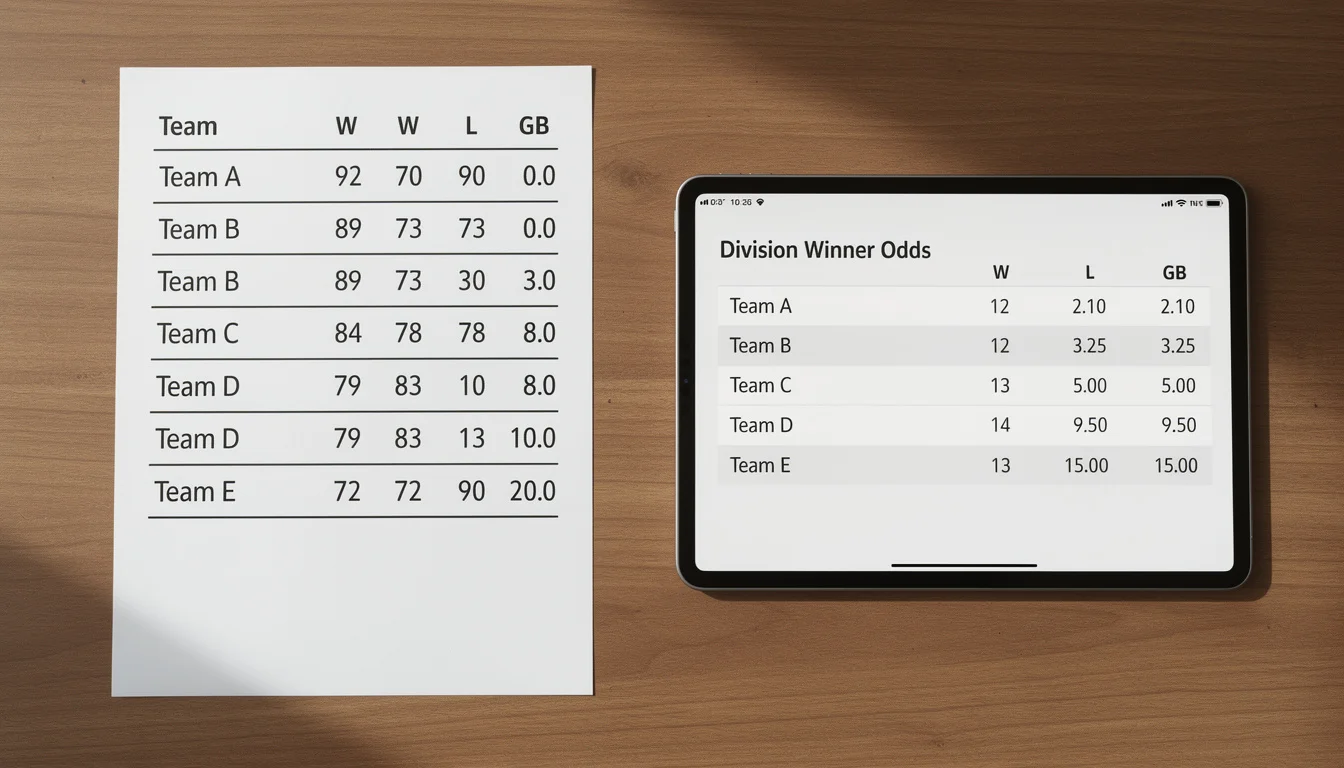
Table of Contents
- Why Division Futures Are the Calmest MLB Market
- The Six Divisions and Their Pricing Personalities
- Why Competitive Balance Matters for the Pricing
- The Wildcard Effect on Division Pricing
- The Trade Deadline as the Single Biggest Pricing Event
- UK Bookmaker Coverage of Division Markets
- Frequently asked questions on MLB division winner odds
Why Division Futures Are the Calmest MLB Market
Major League Baseball is divided into six divisions of five teams each, three in the American League and three in the National League. The winner of each division gets a guaranteed postseason place, a bye through the Wild Card round in most years, and home-field advantage for the start of the Division Series. That structural reward makes division futures the second-most actively traded long-term market on the MLB calendar, sitting just below the World Series outright and above all the individual award markets.
What I have come to appreciate about division futures, after eleven seasons of betting them, is how steady they are compared with everything else in the long-term MLB catalogue. The World Series outright is a 30-team market driven by playoff variance; the division outright is a 5-team market driven mostly by regular-season performance over 162 games. The sample size that determines the outcome is genuinely large, and the variance is consequently lower. Sharp pricing should produce more reliable returns than the World Series outright, even though the prices are shorter.
The 2,430-game regular season is what makes this work. With 162 games per team and only four direct competitors in each division, the law of large numbers reasserts itself. A team that is genuinely the best of five over 162 games will usually finish first; a team that is genuinely a coin flip with one rival will see that coin flip resolve into a clear winner more often than not. Division futures reward correct projections of full-season talent more reliably than they reward correct projections of short-term postseason variance.
The Six Divisions and Their Pricing Personalities
Each of the six MLB divisions has a different pricing personality at UK bookmakers, shaped by the historical track record and the current competitive landscape. The American League East has been the most competitive division in baseball for two decades, with multiple teams capable of winning in any given year and prices that rarely run shorter than 2.5 on the favourite. The American League West has often been a two-team race between the historical powers. The American League Central has typically been the weakest division, with the winner priced as a heavy favourite and several rebuilding teams running out to triple-digit decimals.
The National League East has flipped between competitive and one-sided across the past five seasons, with multiple recent champions emerging from different teams. The National League Central has trended back toward two-team competition after a period of dominance by a single club. The National League West is currently the most concentrated division in the league, with a single team priced at decimal 1.40 or shorter pre-season for several consecutive years.
The pricing personality matters because it tells you where value lives. In a one-team division priced at 1.30, the only realistic value bet is on the favourite continuing to dominate (which the price already implies) or on a long shot capturing a freak season — and the long shots in that scenario are usually correctly priced as long shots. In a competitive division priced 2.5 on the favourite and 3.2 on the second-favourite, there is structural value if you can identify which side is being marginally overpriced.
The 71,409,421 total MLB attendance figure for 2025 reflects strong fan engagement across all six divisions, which in turn means UK bookmaker volume is broadly distributed rather than concentrated. The casual money does favour the marquee teams — Yankees, Dodgers, Red Sox — but it does not overwhelm pricing in the way it does on the moneyline for those same teams’ individual fixtures. Division futures are a calmer market with more dispersed liquidity.
Why Competitive Balance Matters for the Pricing
The competitive balance within a division is the single most important variable for division futures pricing. A division with five evenly matched teams produces a wide spread of opening prices and tight closing prices as the season progresses. A division with one dominant team produces a short opening price and minimal movement.
The variance of regular-season win totals within a division tells you how sharp the futures pricing should be. If the five teams in a division project at 85-83-79-72-68 wins, the top two are realistic candidates and the bottom three are essentially irrelevant — the market becomes a two-team race priced around 1.7 and 2.2. If the five teams project at 88-84-83-80-78, four teams have realistic claims and the market becomes a tighter four-way race priced 2.5/3.0/3.4/4.5 with the bottom team as the long shot.
What casual UK punters miss is that the projected win-total distribution has a much bigger impact on division futures than on World Series futures. The World Series outright sums across the entire 30-team league and is dominated by playoff variance; the division outright is a head-to-head competition between five known competitors and is dominated by talent and depth.
The individual award futures mostly settle inside divisions, which means an MVP race often correlates with a division race because the MVP candidate’s team needs to win to anchor the narrative. Division futures and MVP futures together can produce correlated exposure — if I am backing a player for MVP, I am implicitly also exposed to that player’s team winning the division. Smart bankroll management treats these as related rather than independent bets.
The Wildcard Effect on Division Pricing
The expansion of the postseason to twelve teams created an interesting secondary market. The three Wild Card spots in each league mean that finishing second in a division is no longer the end of the postseason story — it can still produce playoff baseball. That dilutes the urgency of the division race for the second-place team but does not affect the actual division winner.
The pricing implication is subtle. UK bookmakers do not generally adjust division winner prices based on Wild Card availability, because the rules of the division winner market are clean — first place takes the prize, second place does not. But the market behaviour of the teams involved does shift. A team trailing the division by five games in early September with a clear Wild Card spot already secured will rest starters, manage bullpen workloads, and effectively concede the division race in favour of postseason readiness. That late-season behaviour can shift division winner prices in the final weeks even when the standings have been stable.
What that means for late-season division futures betting is that the line moves you see in September are sometimes about player rest decisions rather than about win projections. A team trailing by three games whose ace is being shut down for arm management is no longer a real threat to the division; the bookmaker price will reflect that as the news breaks. Sharp bettors who track team news closely capture small edges in late-September pricing.
Conversely, a Wild Card team with no clear postseason seeding incentive will sometimes play harder for the division winner than the standings imply, because the home-field advantage in the Wild Card round is meaningful. The strategic calculus of the final two weeks of the season can be different from the win-total projection that drove the opening line.
The Trade Deadline as the Single Biggest Pricing Event
The MLB trade deadline at the end of July is the single biggest mid-season pricing event for division futures. Teams that are contending acquire help; teams that are out of contention sell off assets. Every trade changes the talent distribution within multiple divisions, and the bookmaker pricing engines have to reprice quickly.
The 24 hours after the trade deadline closes is the most active pricing window of the entire season for division futures. Markets that have been steady for weeks can move 15-20 cents in either direction overnight as the bookmaker absorbs the new talent reality. UK punters who follow the deadline closely and place positions in the immediate aftermath capture the bookmaker’s reactive repricing.
The asymmetry to be aware of is that not all trades are equal in their effect on division futures. A trade that adds a star starter to a contending team’s rotation can move the division price by 8-12% of implied probability. A trade that adds a bullpen arm or a backup utility player typically moves the price by 1-2%. The bookmaker pricing engines weight these correctly, but the casual public often overreacts to high-profile names regardless of actual impact, creating brief soft spots in the market.
The teams that sell at the deadline produce the inverse opportunity. A division leader whose direct competitor sells off two starters and a closer effectively has the division handed to them, and the futures price compresses dramatically. If you hold a position on that division leader from the spring, the trade deadline can lock in much of your gain through compression — which is when you should consider closing the position or hedging the runner-up.
UK Bookmaker Coverage of Division Markets
Division futures markets are offered by most UK-licensed bookmakers covering MLB, but the depth of associated markets varies more than it does for World Series outrights. The premium operators offer not just division winner but also division winner without specific teams (handicap markets), winning margin by team, and division top-two finishes. The mid-tier operators tend to offer just the headline division winner. Some smaller books skip division futures entirely and concentrate on the World Series outright alone.
What I have noticed across operators is that the pricing differences between UK books are often larger on division futures than on individual moneylines. A team priced at 2.3 to win its division at one operator might be 2.5 at another and 2.65 at a third. Line shopping across two or three books on division futures generates measurable expected value gains over time — much more than equivalent line shopping on regular-season moneylines, where margins are tighter.
The reason for the wider price dispersion is that division futures are lower-volume markets, which means the bookmaker pricing engines do less liquidity-driven sharpening on them. Sharp money flows into moneyline markets where bookmakers know they are being graded; division futures get less of that scrutiny and so the prices drift further from consensus.
Frequently asked questions on MLB division winner odds
Do wildcards void a division winner market?
No. The division winner market settles on whichever team finishes with the best win-loss record in the division, regardless of which other teams qualify for the postseason through the Wild Card route. A second-place team reaching the Wild Card does not affect the division winner bet — first place wins, second place loses. The two markets are entirely independent.
How does the trade deadline shift division winner odds?
The 24-hour window after the late-July trade deadline produces the largest mid-season pricing moves in division futures. Teams adding star starters can shorten by 8-12 percentage points of implied probability; teams selling can drift by similar margins. The pricing typically stabilises within a few days as the bookmaker engines digest the new rosters, so the immediate post-deadline window is the most actively traded period of the season.
Created by the ”mlb Online Betting” editorial team.