MLB Totals: How Over/Under on Runs Works
 Available in US
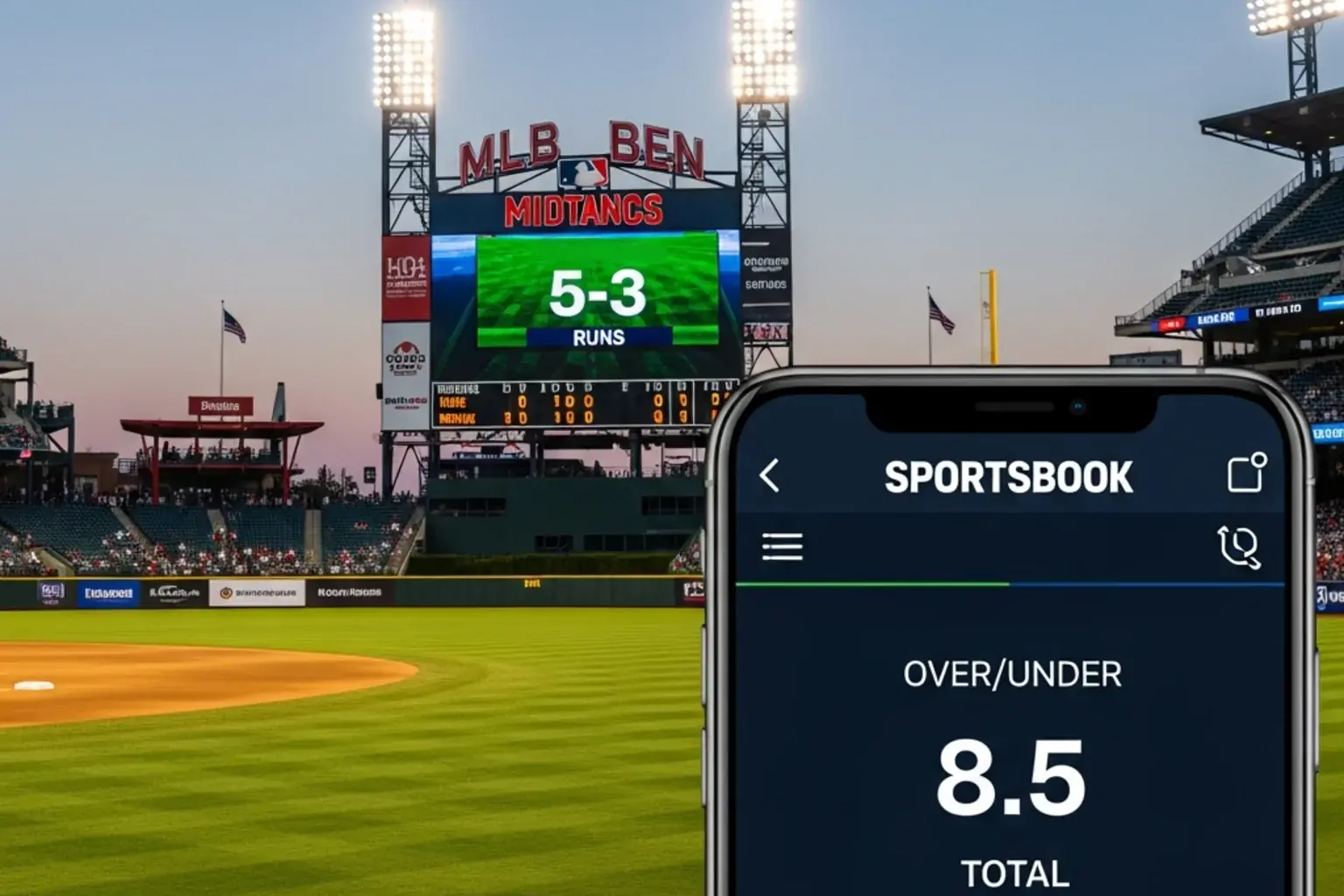
Table of Contents
- The market that runs on weather forecasts and tired arms
- How a totals line is actually born
- The typical range and why outliers matter
- Extra innings: the rule that catches everyone once
- Over bias, under bias, and the recency trap
- Live totals: pitching out, runners on, line moving fast
- Frequently asked questions on MLB totals betting
The market that runs on weather forecasts and tired arms
The first total I ever lost on cleanly was an under at 8.5 in San Diego that finished 12-4. The wind had shifted from “in” to “out” by the third inning, and the line that looked locked at first pitch was suddenly an over-cooker. That game taught me what every serious MLB totals bettor learns eventually: this market is not about the two teams. It is about the conditions in which they play.
An MLB total is a bet on the combined number of runs scored by both teams in a single game. You take the over if you think they will score more than the posted line, the under if fewer. The line is almost always set with a half-run, like 8.5 or 9, so there is no possibility of a tie unless the book posts an integer total — in which case a finish landing exactly on the line refunds the stake.
The 2025 season ran with an average game time of 2 hours 38 minutes, a third straight season inside that 2:40 ceiling. The pitch clock — introduced in 2023 and tightened since — has not reduced run scoring in the way some predicted, but it has reshaped the variance. Games end faster, late-inning blowouts happen less often, and totals lines have nudged down by about half a run league-wide compared with the pre-clock era. That structural shift matters because every model built on pre-2023 data is silently mispricing the current market.
The other piece worth flagging up top: totals are where the smart money goes when the moneyline and run line both look fairly priced. There is more analytical edge available in pricing weather, ballpark, and bullpen than in second-guessing which team wins a coin flip. UK bookmakers have improved their totals pricing meaningfully over the past three seasons, but they still lag the sharpest US operators by a percentage point or two on the closing number.
How a totals line is actually born
Watch a trading desk price a totals market and you see something almost mechanical. They start with the two starting pitchers and work outward from there.
The starting-pitcher inputs are runs-allowed projections — usually expressed in expected runs against the average lineup over the pitcher’s projected innings. A starter projected for six innings with a 3.40 expected ERA contributes 2.27 expected runs against. Layer in the bullpen behind him (the relievers who will pitch the final three innings) using their recent weighted ERA, and you have the projected runs against one offence. Repeat for the other side, sum the two projected runs-against numbers, and you have a raw total.
Then come the multipliers. The ballpark factor — a multiplicative coefficient for how many runs that venue allows relative to league average — is applied next. Coors Field carries a park factor around 1.20, meaning runs score 20 percent above average there. Petco Park hovers near 0.92. Weather is the third layer: wind speed and direction, temperature, humidity, all combine into a small adjustment that can move a total by half a run on extreme days. For the full park-factor methodology, the park factor framework used in MLB betting spells out how those coefficients are calculated and updated.
The number that comes out of this process is the model total. The trading desk then nudges it based on opening market data from competing books and posts a line, usually one to two days before the game. From that point, money moves the price. Late line movement in MLB totals is more informative than late moneyline movement — it tends to reflect updated weather forecasts and confirmed lineup news rather than recreational dust.
About 290 million online sports bets are placed monthly across the UK market in 2025. MLB totals are a tiny slice of that figure, but they punch above their weight in betting density at peak summer evenings when transatlantic books overlap their trading hours.
The typical range and why outliers matter
League-average MLB totals across 2025 settled around 8.5 to 9 runs, with summer averages climbing closer to 9.5 and April figures sometimes dipping to 7.5 in cold-weather venues. Knowing this range is the difference between recognising a real price signal and getting mugged by it.
Most totals lines on a given day will cluster in a narrow band. If you see fifteen MLB games on the slate and twelve of the totals sit between 8 and 9, the three outliers — a 7 or a 10.5 — are doing something specific. The 7 usually means two aces at a pitcher’s park with cool weather. The 10.5 usually means Coors Field, a hot evening, and two starters with ERAs above 5.
The trap is assuming the extreme totals are mispriced because they look extreme. They almost never are. A 10.5 at Coors is not generous over-territory; it is the trading desk acknowledging that runs at altitude come in floods, and that historical Coors averages over the past five seasons have included games at 13.5 and 14. The line is high because the venue is high. Betting the under at Coors because “10.5 looks like a lot” is the kind of decision that loses money slowly across a season.
The interesting prices live in the middle of the slate. A game at 8.5 with both starters on short rest, a hitter-friendly park, and a wind blowing out is mispriced if the book has not refreshed the line with the morning weather forecast. Those moments are where edges live. They demand watchfulness; they do not announce themselves.
Extra innings: the rule that catches everyone once
Extra innings count toward the total. Every run scored after the ninth inning is included in the over-under settlement. I have to repeat this fact to friends every spring, because the instinct is to assume the bet “ends” at nine innings.
The implications are real. A 4-4 tie heading to extras pushes the total to 8 runs after nine innings. If the line was 8.5, the under is winning until a single run is scored in the tenth or beyond. The “ghost runner” rule that places a runner on second base to start each extra inning was a permanent regular-season fixture by 2024, and that rule meaningfully changes the run-scoring probability per extra frame. Most extra innings score at least one run somewhere.
The 2025 World Series Game 3 ran 18 innings — exceptional, but it underlines what extra-innings exposure means for unders. The longer the game stretches, the more likely runs score, and the under sweats every additional half-inning. Knowing this in advance lets you make rational live decisions. If your under bet is 1-1 heading to extras, the bet is still alive but variance has tilted against you. Sometimes the right move is to hedge live; sometimes it is to ride out the variance you bought.
Postseason rules differ from regular-season rules in some technical respects (no ghost runner historically in playoffs, though MLB has experimented with that), but the basic principle holds: extra innings settle into the total.
Over bias, under bias, and the recency trap
Public money in MLB overwhelmingly leans toward the over. The reason is psychological — betting on runs feels exciting, betting on no-runs feels like rooting for a chess match. That bias creates a measurable structural value on the under, but only at certain prices and in certain conditions.
The over bias is strongest on prime-time national TV games and on slates featuring heavy hitting teams. The under value is strongest on midweek day games, smaller-market matchups, and pitcher’s duels that get little TV exposure. UK punters watching MLB at three in the morning are insulated from much of the public over-bias because they are not betting alongside the recreational US Saturday-night crowd. That timing advantage is real.
The recency trap goes the other way. After a slate of three over-cooked games at a venue, the line at that venue creeps upward — sometimes by 0.5 or even a full run over a few weeks of high-scoring outputs. The under value emerges precisely when the line has chased the wrong information. A ballpark’s true factor takes hundreds of games to average out, so a hot run of overs at, say, Globe Life Field tells you almost nothing about whether the over at 10 next Tuesday is reasonable.
One bias that does hold up: cold-weather April baseball undershoots line averages more reliably than summer baseball overshoots. Pitchers struggle for command in cold air but offences struggle more — a phenomenon clear in early-season totals data year after year.
Live totals: pitching out, runners on, line moving fast
The pre-game total is one bet. The live total is fifteen different bets, each priced on a different game state. A 1-0 game in the fourth inning with both starters in command has a live total of perhaps 6.5. The same game in the seventh, with bullpens warming and runners on the corners, jumps to 8.5 or higher.
Live totals on MLB are some of the most volatile lines any UK sportsbook quotes. The market moves on every pitch, suspends briefly between batters, and reopens at adjusted prices. Latency varies — most UK operators run a stream delay of 8 to 30 seconds versus the live MLB.TV broadcast, and that gap is enough to make in-play decisions risky if you are watching the game on a different stream than the bookmaker’s.
The cleanest live-totals angle is a pre-game over at 9 that opens 1-0 after two innings, with the under live priced at 1.65. If your pre-game model said the over was good value, the under at this new price is genuinely good value the other way — you can lock a position. This is not arbing; it is portfolio rebalancing on volatility. Many UK regulars use live markets exclusively for this kind of mid-game positioning rather than for fresh first-pitch bets.
Two friction points to keep in mind. Liquidity drops on smaller-book live MLB markets — Spreadex and similar mid-tier UK books often have lower live limits than bet365 or Betfair. And cash-out values offered live are almost always worse than mathematically fair; UK regulators have been pushing for more transparency on cash-out maths, but the gap remains.
Frequently asked questions on MLB totals betting
What is a typical MLB run total range?
Most lines fall between 8 and 9 runs for an average matchup. Cold-weather April games and elite pitching duels can drop to 7 or 7.5. Coors Field in summer, with two weak starters, routinely sees totals at 11 or higher.
Do extra innings count toward an MLB over/under?
Yes. Every run scored after the ninth inning is included in the total settlement. A bet on the over to 8.5 in a 4-4 game heading to extras is still alive until a single extra-inning run pushes the score above 8.
Why does the pitch clock affect MLB totals?
The pitch clock shortens games and tightens late-inning variance, which has nudged league-wide totals down by roughly half a run since 2023. Models built on pre-clock data underestimate the structural change and can misprice the under by a tick.
Published by the mlb Online Betting team.